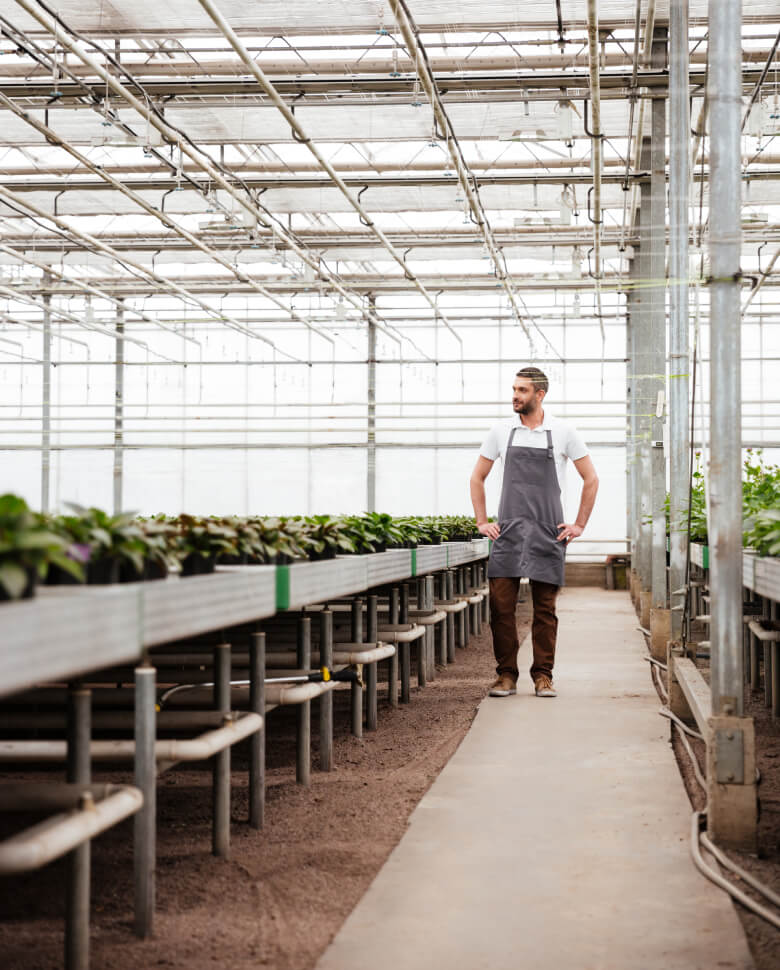
100% Glass Greenhouse
At Mega Agro, we combine modern agricultural technologies with sustainable production principles to produce soilless (hydroponic) tomatoes in greenhouses constructed entirely of glass. Our 100% Glass Greenhouse approach aims to maximize plant health, productivity, and product quality while minimizing environmental impact.
Why 100% Glass Greenhouse?
Natural light optimization: Fully glass structures allow for maximum sunlight intake throughout the day; This increases photosynthesis efficiency and accelerates growth cycles.
Light spectrum stability: Glass transmits UV and visible light spectrum more evenly, preserving the positive contribution of natural light to plant development.
Durability and transparency: The long-lasting structure and optical transparency of glass provide advantages in energy efficiency and indoor climate control.
Our Advantages in Soilless Tomato Production
High quality, consistent flavor: With precise control of nutrient solutions, homogeneous ripeness and taste profile are ensured in every harvest.
Water efficiency: With our closed-loop hydroponic systems, we significantly reduce water consumption compared to traditional agriculture.
Disease control: Thanks to the soilless infrastructure and sterile environment, the risk of soil-borne pests and pathogens is minimal.
Area efficiency: We maximize yield per square meter with vertical arrangement and high-density planting strategies.
Continuous quality control: Nutrients, pH, EC, temperature, and humidity are monitored instantly with sensors and automation; parameters are kept within the ideal range with automatic corrections.
Sustainability and Environmental Approach
Energy optimization: Our heating, cooling, and circulation systems operate with energy-efficient equipment and intelligent control software; Suitable for renewable energy integration.
Water recycling: Irrigation and drainage waters are treated and reused in the cycle.
Minimum chemical use: We reduce pesticide use with integrated pest management (IPM) and biological control methods.
Local supply chain: We reduce the carbon footprint from transportation by planning our production in locations close to local markets.